Introduction
In
teaching, the uses of model and simulation would give big impact towards
students. Nowadays we can see that students are more attracted to technology
that can be seen as more interactive and fun. They love to explore the
technology that being increase day by day. In the process of making a
development country, do some paradigm in way of teaching would be very helpful.
Thus, the percentage to evolve brilliant and educated students is higher. The
uses of model and simulation can eventually helps students to be more critical
thinking and creative.
According
to Shannon, model can be defined as a representation an object, a system or an
idea in some form rather than that of the entity itself. Model itself can be
divided into two type which are in physical model and on mathematical model. Model
is something realistic that is exist. By using model or we call it as hands-on
learning as teaching tools will make students be more understand and remember
easily because our brain will remember for a longer time for things that can be
seen and can be touch. Like what people said, “ I hear and I forget, I see and
I remember, I do and I understand” In order to engage students and introduce,
practice, or remediate a variety of scientific concepts especially, this kind
of teaching tools is very useful yet seem legit.
Student Motivation
Teachers who embrace hands-on or
modeling learning and incorporate manipulative into their everyday lesson plans
introduce their students to an intuitive way of learning, and empower them to
succeed. For instance, Biology teachers that have used a hands-on approach to
teaching have experienced some benefits to make teaching more interactive. With
a model to show, students are able to remember material better, and feel a much
greater sense of accomplishment when the task is completed. This is because
students have a better chance of understanding and retaining concepts that are
taught using models. Next, students jobs who have
difficulty learning due to language barriers, auditory deficiencies, or behavioral
issues have a much easier time stay engaged and on task when manipulative models
are introduced. Most importantly, students enjoy learning about science when
manipulative models are used. Karina LeBlanc, VP, Autism Pro. remarks that,
when using manipulative models, the students are excited about science, eager
to get to class, attentive and taking initiative. Therefore, students have a
much easier time learning and process information when they are having fun and
genuinely interested in the project at hand.
On the other
hand, a simulation of a system is the operation of a model in which represent
that system. The model is amenable to manipulation which would be impossible,
too expensive or too impractical to perform on the system which is portrays.
Besides that, the operation of the model can be studied and from this,
properties that concerning the behavior of the actual system can be inferred.
There
are many applications that can be done with simulation in not only in studying
field but also in other field. For
instance, simulation can be applied in designing and analyzing manufacturing
systems. Evaluating H/W and S/W requirements for a computer system also can
apply the simulation. Besides that, simulation also can evaluating a new
military weapons system or tactics so that more cost can be cut off while the
armies practicing. Moreover, simulation also can be used to determining
ordering policies for an inventory system other than designing communication
systems and message protocols for them. Designing and operating transportation
facilities such as freeways, airports, subways and ports also can apply the
uses of simulation. This will make the process easier. Next, the application of
simulation also can evaluating designs for service organizations such as
hospitals, post offices and fast food restaurants. By simulated this, it can save
the cost compared if we used the real design before being publish. Analyzing
financial or economics systems are better to use simulation due to rapid
changes of this sector.
There
are few steps that need to do to create simulation and model building. Firstly,
an achieve goal need to be defined so that the thing being done in right track. To do so, we acquire a question
that will trigger the production of goal. For instance, ask our self why we
need to teach by using simulation. After a question being asked, answer it as
way to keep a goal. For example, why we need to teach with simulation and the
answer is for a deep learning. Instructional simulations have the potential to engage
students in deep learning that empowers understanding as opposed to surface
learning that requires only memorization. Deep learning usually will make the
students can apply some knowledge without they need to memorize. A good summary
of how deep learning contrasts with surface learning is being given in
Engineering Subject Centre. Besides that, deep learning means student can learn
scientific methods including how importance to have a model building.
Experiment and simulations itself are the way scientists do their work. By
using instructional simulations, it will gives students concrete formats of
what it means to think like a scientist and do scientific work. In addition for
deep learning, the relationships among variables in a model or in models. Simulation
allows students to change parameter values and see what happens. Students
develop a feel for what variables also are important and significance of
magnitude changes in parameters. For deep learning, data issues, probability
and sampling theory, the simulations can help students understand probability
and sampling theory. Furthermore, instructional simulations have proven their
worth many times over in the statistics based fields. The ability to match
simulations results with a n analytically derived conclusion especially
valuable in beginning classes, where students often struggle with sampling
theories. Besides that, given the utility of data simulation, it is not
surprising that SERC has an existing module on teaching with data simulation.
This thing is how we want to use a model to predict outcomes. Simulations help
students understand that scientific knowledge rests on the foundation of
testable hypothesis.
In
addition, by doing a simulation we can learn to reflect on and extend knowledge
by actively engaging in student-student or instructor-student conversations
needed to conduct a simulation. Instructional simulations by their very nature
cannot be passive learning. By doing this also, students are active
participants in selecting parameter values, anticipating outcomes and
formulating new questions to ask. We will also learn to reflect on and extend
knowledge by transferring knowledge to new problems and situations. A well done
simulation is constructed to include an extension to a new problem or a new set
of parameter that requires students to extend what they have learned in an
earlier context. Also, by understanding and refining their own thought processes,
a well done simulation includes a strong reflection summary that requires
students to think about how and why they behaved as they did during the
simulation. In addition, seeing social processes and social interactions in
action. This is one of the most significant outcomes of simulation in social
science disciplines such as sociology and political science.
Furthermore,
we also can set a goal by questioning how to teach with simulations. This can
be explained by instructor preparation is crucial. The good news is that,
instructional simulation can be very effective in stimulating student
understanding. Whereas, the bad news is that many simulations require intensive
pre-simulation lesson preparation. The lesson preparation is varies with the
type and complexity of the simulation. The important thing in this deep
learning for simulation is that, active student participation is crucial. Student
participant is important because students learn through instructional
simulations when they are actively
engage with some simulation. Students also should predict and explain
the outcome they expect the simulations to generate. Moreover, in every effort
that being given should be made to make it difficult for students to become
passive during simulation. Students must submit timely input and not rely on
classmates to play for them. Instructor, in this contact is a teacher should
anticipate ways the simulation can go wrong and include this in their
pre-simulation discussion with the class. Besides that, post-simulation
discussion is crucial. Post-simulation discussion can be a deeper learning by
students who become the leader. Teacher should only provide sufficient time for
students to reflect on and discuss what they learned from the simulation.
Teacher also can have a two-way interactions by ask students explicitly asked
on how simulation can help them understand the coarse goals or how it may have
made the goals become more confusing. In this post-simulation discussion also,
teacher can integrate the course goals into the discussion.
Secondly,
in teaching by using simulation and model building need to put together a
complete mix if skills on the team. This will absolutely create a titanic ideas
that will attract students to look at the simulation and model heart fully. What
we teacher need to do is to have more statistical skills which is output data
analysis. Even more statistical skills which is design of experiment must also
being done. We also need to have a management skills to get everyone pulling in
the same direction. Third step in simulation and model building is it involve
the end user. While making a modeling, it is like we selling something.
Therefore, we need to make people believe on the results that being made and
right away will anyone put the results into action. The End-user which is our
students can and must do all the action that being introduced from the
beginning. However, if the students want to do it, they must be convinced. We
teacher, must believe in our model and simulation that the thing is do the
right thing that can be seen as real.
Fourthly,
steps that we must obey to do in simulation and model building is to choose the
appropriate simulation tools. The appropriate tools is very important because
it will affect the simulation and model that being used. There are three
alternatives that teacher can use which are build a Model in general purpose
language, build a model in general simulation language and also use a special
purpose simulation package. Next, model the appropriate simulation level of
detail. This step is also important. For the starting, teacher should define
the boundaries of the system of simulation to be modeled. There are some
characteristics of the environment which is outside of the boundaries that may
need to be included in the model. Teacher should pay attention to this which is
not all subsystems will require the same level of detail. Besides that, by
modeling the appropriate level of details also, teacher can control the
tendency to model in great detail those elements of the system which are well
understood, while skimming over other, less well and also must be an understood
sections.
The
sixth steps is teacher need to start early to collect the necessary input data.
Teacher must realized that data comes in two quantities which are either too
much or too little. So, by started earlier, with too much data, teacher need a
techniques for reducing it to a form usable in modeling or simulating.
Nonetheless, when there are too little data, teacher need information which can
represented by statistical distributions. Furthermore, steps that teacher have
to do in order to attract students by teaching using simulation is that,
teacher should provide adequate and on-going documentation. Generally, as we
know that programmer that design programmer love to program a programmer.
Documentation is always their lowest priority item. What teacher can do are,
teacher should use self-documenting languages, insist on built-in user
instruction to help in screens and also teacher can set or insist on a standard
for coding style. This would helps a lot.
Last
but not least is, develop plan steps. There are three develop plan that can be
done. One, teacher can develop plan for adequate model verification. It is like
either teacher get the right answers. Basically simulation provides something
that no other techniques can do which are step by step tracing of the model
execution. This technique would provides a very natural way of checking the
internal consistency of the model. The next develop plan is for model
validation. Validation can be seen as “does the right thing” or “asking the
right questions”. Not only that, teacher can also questioning how do we know
our model represents the system under investigation and compare to existing
system or deterministic case. Next develop plan is a plan for statistical
output analysis. Teacher can questioning how much is enough for long runs
versus replication and find techniques for analysis.
Prediction
STELLA can applied to be a
simulation and model building in school to attract students. It can be a
prediction on experiment that we wanted to do but we want to reduce cost.
Making another to another experiment without use simulation is actually will
become a waste. Education and research are most
exciting when they move out of the lecture hall and library and provide
opportunity to create, experience, and see. STELLA offers a
practical way to dynamically visualize and communicate how complex systems and
ideas really work.
Neither
they are first-time nor experienced modelers, teachers, students, and
researchers can use STELLA to explore and answer endless questions like “How
does climate change influence an ecosystem over time?” , “Would Hamlet’s fate
have changed if he’d killed Claudius earlier?” , “How do oil prices respond to
shocks in supply and/or demand?” , “What will happen when the ozone layer is
gone?” and “How do basic macroeconomic principles affect income and
consumption?”
Teacher know that students have learned when they can in
turn they would explain it. STELLA models allow teacher to communicate how a
system works. For instance, question of what goes in, how the system is
impacted, what are the outcomes can be answered yet be simulated. STELLA supports
diverse learning styles with a wide range of storytelling features. Diagrams,
charts, and animation help visual learners discover relationships between
variables in an equation. Verbal learners might surround visual models with
words or attach documents to explain the impact of a new environmental policy.
Usually,
STELLA being used to simulate a system over time. Besides that, STELLA also use
to jump the gap between theory and the real
world. Students sometime cannot imagine something that need to be
imagined. With this kind of simulation, it would helps a lot. Therefore, it
will enable students to creatively change systems. Furthermore, by simulation
it teach students to look for relationship of experiment by seeing the bigger
picture. By using this simulation of STELLA also, it can be a clear
communication system inputs and outputs
also demonstrate outcomes.
There
are many more STELLA can do such as mapping and modeling. Intuitive icon-based
graphical interface simplifies model building, enhanced stock types enable
discrete and continues processes with support for queues, ovens and enhanced
conveyors. By using this simulation also, a model equations can automatically
generated and made accessible beneath the model layer besides of modules
support multi-dimensional arrays that simply present repeated model structure. Besides
that, this STELLA can do simulation and analysis. This simulation is
sensitivity analysis reveals key leverage points and optimal conditions. It
also can be partial model simulations focus analysis on specific sectors or
modules of the model. It also can results a presented as graphs, tables,
animations, QuickTime movies and files. This STELLA can also use in
communication and many more.
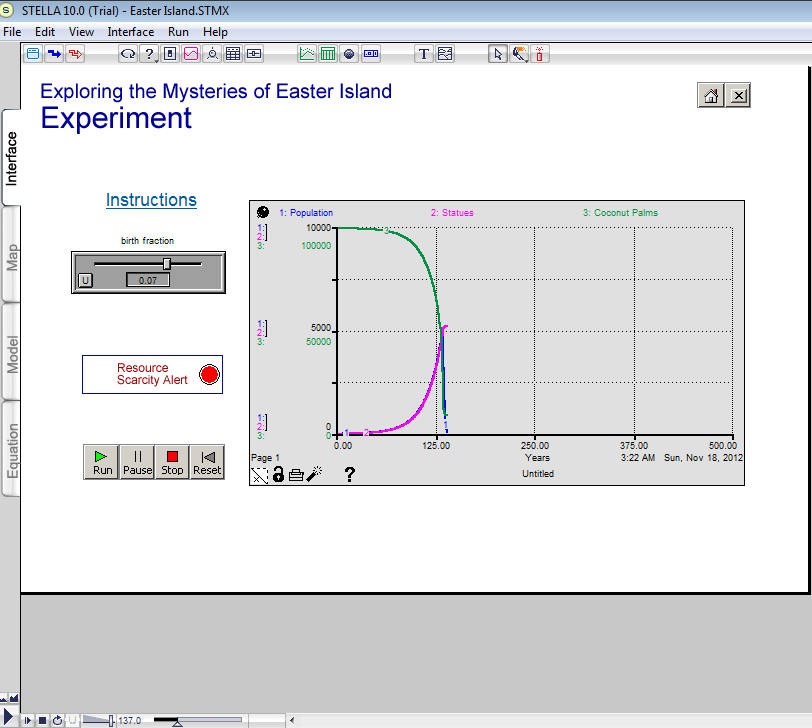
Exploring The Mysteries of Easter Island
An experiment of simulation had
been chose to show how simulation can predict what would happen in the island.
The manipulated variable is on birth fraction in the island. I had change three
manipulated variable to see the changes. This would be the prediction.
For birth fraction 0.05 which is
the original birth fraction without changing the variable, the yellow light
which shows warning for resource scarcity alert with value of interception of
209 of population, statues and coconut palms. The next picture beside it is the
red light resource scarcity alert with interception at 217.5
By applying STELLA simulation,
we can change the manipulated variable to the lowest part of birth fraction.
The picture of birth fraction 0.03 above shows that, the resource security
alert predict a green light with that amount of birth fraction. Thus, student
can say that it would be good to have this amount of birth fraction.
Next, if the
birth fraction have been increased, it shows a different results. The birth
fraction become more faster than before either in yellow light or red light
warning. This shows the simulation actually can predict up to very much seems
to be accurate results. This is because all of the experiment have been analyze
before published. Thus, teacher can do some question to student to know what
are their prediction. After they had
predicted, teacher can check the results. The results of birth fraction of 0.10
like picture below is the most faster alert which shows a very dangerous
population, statues and coconut palm can be. After that teacher can gives
conclusion to the simulation that had been done.
Conclusion
Simulation
is the imitation of the operation of a real world process or system over time. The
act of simulating something first requires that a model be developed, this
model represents the key characteristics or behaviors of the selected physical
or abstract system or process. The model represents the system itself, whereas
the simulation represents the operation of the system over time.